
Ayurveda, the timeless Indian science of life, teaches that everything in the universe — including the human body — is composed of five essential elements, known as the Panchamahabhutas. These are Space (Akasha), Air (Vayu), Fire (Agni), Water (Jala), and Earth (Prithvi). Together, they form the structural and functional basis of all matter, both living and non-living.
Ayurveda views the human body as a microcosm of the macrocosm — a reflection of the universe within itself. Just as the cosmos is sustained by these five elements, so too are we. Every aspect of our physical, mental, and emotional existence is influenced by their interaction and balance.
How the Five Elements Express Themselves in the Human Body
Each of the five elements manifests in unique ways within us:
- Space (Akasha): Space represents openness and expansion. It is found in the hollow cavities of the body — the mouth, nostrils, abdomen, and chest. It allows movement and communication to occur.
- Air (Vayu): Air governs all motion in the body — from the beating of the heart and the movement of muscles to the circulation of blood and transmission of nerve impulses.
- Fire (Agni): Fire symbolizes transformation. It is the force behind digestion, metabolism, and vision. The body’s heat, luster, and intelligence are all governed by Agni.
- Water (Jala): Water signifies cohesion and fluidity. It maintains lubrication, forms bodily fluids like plasma and saliva, and supports digestion and joint movement.
- Earth (Prithvi): Earth represents stability and structure. It gives solidity to bones, muscles, teeth, and tissues — the framework that supports life.
Together, these five forces create the physical body, sustain its functions, and maintain its integrity. Their harmony ensures health; their imbalance leads to disorder.

From Elements to Doshas: The Biological Energies of Life
In Ayurveda, these five elements combine in specific ways to create the three Doshas — Vata, Pitta, and Kapha, which govern all physiological and psychological processes.
- Vata Dosha (Space + Air):
Vata governs all movement — from breathing and blinking to circulation and elimination. It embodies qualities such as lightness, dryness, coldness, and mobility. When balanced, it promotes creativity and vitality; when disturbed, it can lead to anxiety, dryness, and irregularity. - Pitta Dosha (Fire + Water):
Pitta is responsible for digestion, metabolism, and transformation. It represents heat, sharpness, and intensity. A balanced Pitta supports intelligence and courage, while an aggravated one causes irritability, inflammation, and acidity. - Kapha Dosha (Earth + Water):
Kapha governs structure, lubrication, and stability. It embodies heaviness, coolness, and smoothness. When balanced, it brings calmness, strength, and endurance; when imbalanced, it leads to lethargy, congestion, and weight gain.
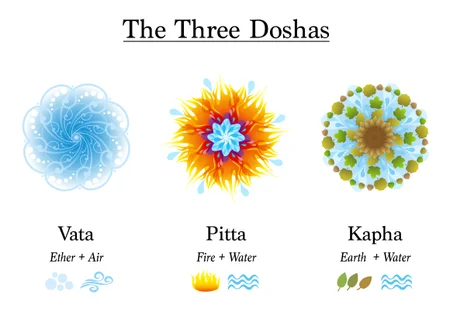
These Doshas are the biological expressions of the five elements and form the cornerstone of Ayurvedic diagnosis and treatment.
The Evolution of Panchamahabhutas
Ayurvedic texts describe a fascinating process through which the five elements evolved from one another, each carrying the essence of the previous.
- Akasha (Space): The first element to manifest, representing vastness and subtlety. Its sensory attribute is sound (shabda) and its property is non-resistance (apratighata).
- Vayu (Air): Emerges from space and brings movement. Its sensory attribute is touch (sparsha) and it retains the quality of sound.
- Agni (Fire): Evolves from air, symbolizing heat and transformation. Its sensory attribute is sight (rupa), and it carries forward sound and touch.
- Jala (Water): Develops from fire, representing fluidity and taste (rasa). It inherits the properties of sound, touch, and sight.
- Prithvi (Earth): The final and most concrete element, symbolizing solidity and smell (gandha). It holds all preceding qualities, making it the densest of all.
Every form of matter in existence — whether a mountain, a river, or the human body — is composed of these five elements in varying proportions.
The Connection Between Food and the Five Elements
Ayurveda emphasizes that the food we consume is also made of Panchamahabhutas. Once digested by the body’s internal fire (Jatharagni), it nourishes the seven tissues (Dhatus). This concept is described as Samanya Vriddhi Karanam — “like increases like.”
For example, foods rich in the Earth element (like grains or root vegetables) strengthen the body’s structure, while those abundant in the Fire element (like spices) enhance digestion and metabolism. Thus, choosing foods that align with one’s elemental balance promotes health and harmony.

Balance of the Elements: The Essence of Health
Ayurveda defines health as the state in which the Panchamahabhutas are in equilibrium within the body. When these elements are disturbed by improper diet, lifestyle, or emotional imbalance, disease arises. Thus, maintaining harmony between these five forces — through proper food, routine, and awareness — is the true path to wellness.
The Panchamahabhutas are not merely ancient philosophical ideas — they are living principles that shape our daily existence. Recognizing their presence in our body, mind, and surroundings allows us to live in rhythm with nature. When we honor this elemental balance, we experience vitality, clarity, and a deeper connection to the universe itself.